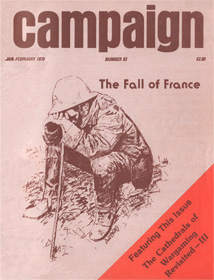
 The January-February 1978 issue of Campaign (#83), featured a historical article originally written for Conflict magazine, which failed before it was published, and the third and final part of Jack Greene’s sequel to his Cathedrals of Wargaming travelogue.
Contents:
The Fall of France * Robert Gennette
The Cathedrals of Wargaming Revisited Part III * Jack Greene, Jr.
Keeping the Colonies Royal * Thomas Dworschak
Panzer Leader: The Encirclement of Nancy * Jeffery Paul Jones
The Economics of Origins * Don Greenwood
Origins ’78 in Michigan: How the Site Was Chosen * Al Macintyre
Suggestions to Improve Future Origins * Al Macintyre
Thumbnail Analysis * Don Lowry
Gamesmanship * Tom Wham
The SDC Report * Dana F. Lombardy & T.P. Schweider
Miniature Warfare * Don Lowry
G2 Reports * Editor
Mail Call
Available on Wargame Vault.

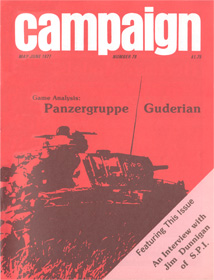 Issue 79 (May-June 1977) saw the final name change to Campaign and a redesign of the cover by Dana Lombardy to a full-bleed image with a ‘featured’ block in the lower-right corner.
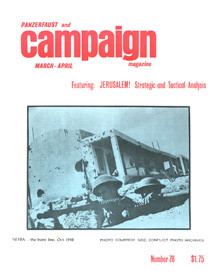 Issue 78 (March-April 1977) of Panzerfaust and Campaign kept the same general cover design as the previous issue.
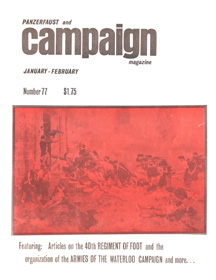 The cover layout changed for issue 77 (January-February 1977) of Panzerfaust and Campaign, avoiding a need for a full bleed, but overall format of the magazine stayed the same.
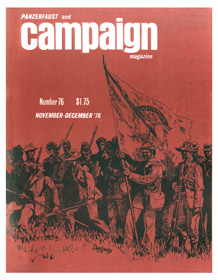 The third full-size issue of Panzerfaust and Campaign (#76, November-December 1976) gained another four pages, but kept the same overall format, and used the same cover illo as #52.
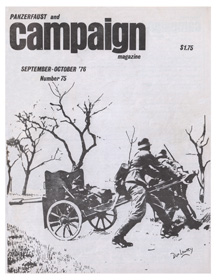 The second full-size issue of Panzerfaust and Campaign (#75, September-October 1976) gained four pages, but kept the same overall format.